Someone recently asked me if I had always wanted to be a scientist from a young age. Not even remotely. The simple truth is, being a scientist was not something that a kid raised in the countryside was wont to dream of. Science teacher? Maybe; my mother was until her recent retirement a high school Chemistry and Biology teacher. The sad and slightly underwhelming truth is that I honestly had no idea what I wanted to do when I grew up. All I knew was that I loved reading books and I was comfortable with doing just that for the rest of my life. Words like ‘doctor’, ‘lawyer’, and ‘architect’ were tossed at me casually, with everyone’s expectation being that since I was an above average student in primary school, I would go on to join one of these traditionally ‘successful’ professions. High school had other ideas.
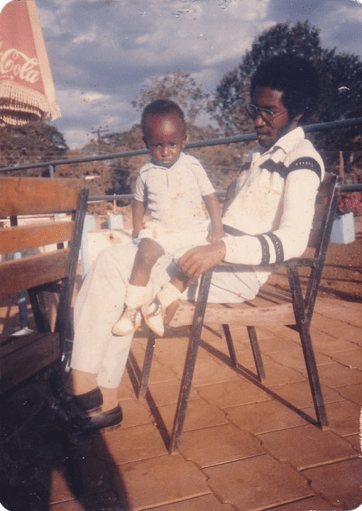
When I first joined Moi Forces Academy in the year 1999, I had every intention of doing well in high school. Indeed, I was very near the top of the class for the first several exams. Then cracks quickly began to show. I was more interested in all the clubs and societies than I was in being an academic achiever. I joined the Debate club, the French club, and the Guidance and counselling club in quick succession. School work went out the window, and by my fourth year, I was barely averaging a B, but I was the clubs and societies captain and president of two clubs. Throughout my high school run, science was never on my radar. All my achievements and awards were in creative writing, debate, drama, music, or art projects. The only time I won anything for a scientific endeavour, it happened to be a project making alcohol out of pineapple rinds. It was all for science, I swear. Luckily, I recovered from my wayward ways just in time before the final, all-deciding examination for high school students in Kenya, squeezing out a barely deserved B+ as my final grade.
To those not familiar with the Kenyan education system, one does not simply take whatever University course they fancy, unless one has rich parents that can pay the high cost of tuition for self-sponsored students. If the goal is to get into a government sponsored school, you have to let the University Joint Admissions Board (J.A.B.) decide your fate and dictate your course (selected from a list of four that you draft from all possible courses) based on your final exam score. At this stage I still had no idea what I wanted to do, but when the J.A.B. contacted me and told me I had been selected to study Range management, I was sure that couldn’t be it. I couldn’t remember selecting that particular course, and I decided that I would transfer and pursue a general course in commerce or economics as soon as I had the chance. However, the first few classes I attended were in Principles of Range ecology and Principles of wildlife management. These classes were fascinating to me and convinced me to stay put and see how deep the rabbit hole went. The pictures of wildlife and promises of frequent field trips to the wild helped a little. At least for a while, the sciences had the upper hand over the humanities.
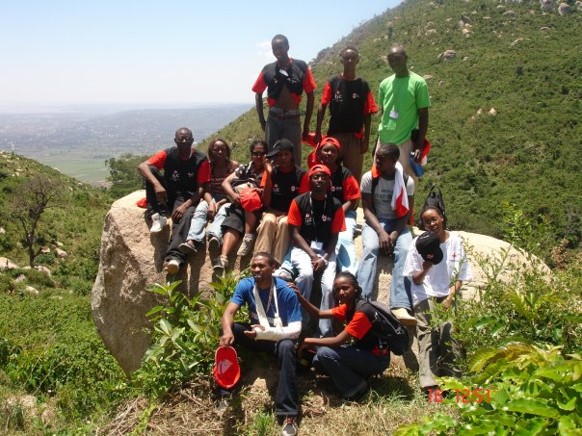
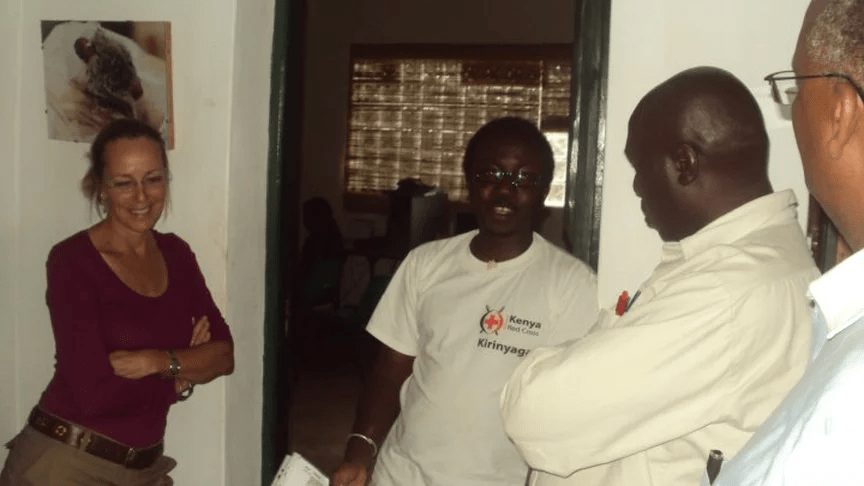
Around the same time as I was starting university, I also joined the Kenya Red Cross as a volunteer. It turned out that the Red Cross and I were made for each other, and I quickly rose through the ranks, even helping plan their 2007 International Youth Camp. I loved the humanitarian life. The youth camps, the first aid trainings, the public accident drills, the workshops and conferences, the clean-ups, the resource mobilization, the making everyone in my small hometown uncomfortable by filling public condom dispensers in broad daylight; I loved it all, and I was good at it. By 2008, I had to make a choice; continue with Range management as my profession, or commit to the Red Cross for a career in humanitarian work. While I was still pondering this decision, Dr. Margaret Kinnaird at Mpala Research Centre, and Dr. Jesse Njoka of the University of Nairobi pitched a Masters’ project proposal to me that would have me studying elephant behaviour in Laikipia, in northern Kenya. Intrigued, I made my choice, stepped down from the Red Cross, and joined the Master’s program in Range management at the University of Nairobi. This would turn out to be the defining moment in my passion for science.
Suffice it to say, before going to Mpala, science was something I did, not something I was. I only cared about science in so far as it would help me get a job. But it is difficult to stay at a place like Mpala, with world class researchers and research facilities, and not get bitten by the bug. Simple conversations at dinner would fill me both with wonder and with more than a touch of the impostor syndrome. These feelings of inadequacy and challenge drove me to want to learn more, know more, be more. I discarded the outdated texts my university professors had been teaching at the University of Nairobi since it began and started reading more cutting edge scientific research from within and beyond our borders. Not satisfied with brushing up on Range ecology alone, I started reading up on other sciences. Richard Dawkins’ books The Selfish Gene and The God Delusion were early thought provoking pieces, as was Neil degrasse Tyson’s op-ed The perimeter of Ignorance. But the biggest spark by far was lit by watching old episodes of the Original Cosmos Tv show, as narrated and presented by Carl Sagan. All these thought leaders inspired me to view science not just as a school subject like the arts and the humanities, but as a way of thinking, a way of life.

In the end, science is to me more than what I do, it is who I am. It is a way of life built on a simple set of principles; question everything, test ideas, build on the ones that pass, discard the ones that don’t. I did not arrive here naturally, I came into science via a rather roundabout and accidental route. But now that I am here, I recognize that I did not have many Kenyan science heroes and icons growing up. The few I knew were mostly conservationists, and they were all white. The others were medical researchers in lab coats that did not seem like they were enjoying themselves very much. Science did not seem like something accessible and ordinary. When I first started designing this website, it was meant to mainly be a showcase of science projects; mine, and my contemporaries. Now I see it playing a different role; a platform for me to play my small role as a science communicator, bringing people closer to the wonders of nature and the cosmos. I see it also as a portal from which to answer common questions and misconceptions. Bear with me as I figure out my voice, but hopefully we can have some fun and learning along the way.
A luta continua (the struggle continues).
 The Accidental Scientist
Leave a comment